








By Brima Sannoh
Fear That Forced a Young Man to Leave
Mohamed Koroma still remembers the day he decided to leave Sahn Malen Chiefdom. It was not because he wanted to abandon his job or his home. It was fear.
A few years ago, Koroma, then a young employee of Socfin Agricultural Company in Sahn Malen, was summoned before the local court over what he describes as a minor dispute. The ruling shocked him. The court fined him NLe 500 and, in addition, ordered him to provide four plastic chairs for the court.
“I didn’t have that kind of money,” Koroma told ManoReporters in an interview. “Even with my work at Socfin, paying such a fine at once was impossible. After the judgment, I became scared. Every day I feared another summons or arrest.”
Unable to raise the money and afraid of further punishment, Koroma fled the chiefdom. He left behind his job, his social ties, and the farmland he had been supporting. For a long time, his family did not know when—or if—he would return.
“I didn’t run away because I was guilty,” he said quietly. “I ran because the punishment was heavier than my life there.”
Koroma’s experience is not unique. Across several chiefdoms in Pujehun District, local and native administration courts continue to impose fines that many residents—especially young people — consider as crushing and excessive. For minor offences, fines can reach thousands of New Leones and even include the seizure of household items such as cooking pots, livestock, or furniture. In some cases, the penalties force young people to flee their communities altogether, like Koroma did.
A Fine That Forced a Woman Out of Town
In Pujehun Town, Adama Kabba, a petty trader, carries her own scars from the local justice system.
Kabba’s ordeal began with a quarrel. A disagreement with her landlord’s wife escalated into an exchange of abusive words. Both women were reported and summoned before the Kpanga Native Administration Court (NAC). According to Kabba, the court ruled that she should pay a fine of NLe 1,000.
“When they told me the amount, my heart dropped,” she recalled. “I sell small things in the market, and I could not pay such a huge sum.”
“Because of the fine, things became too tense for me in Pujehun,” Adama said.
“I had no choice but to leave the town for six months. I was afraid and didn’t know when I would come back. It was only recently, after the tension cooled down and people intervened, that I felt safe enough to return and tried to rebuild my life,” she narrated.
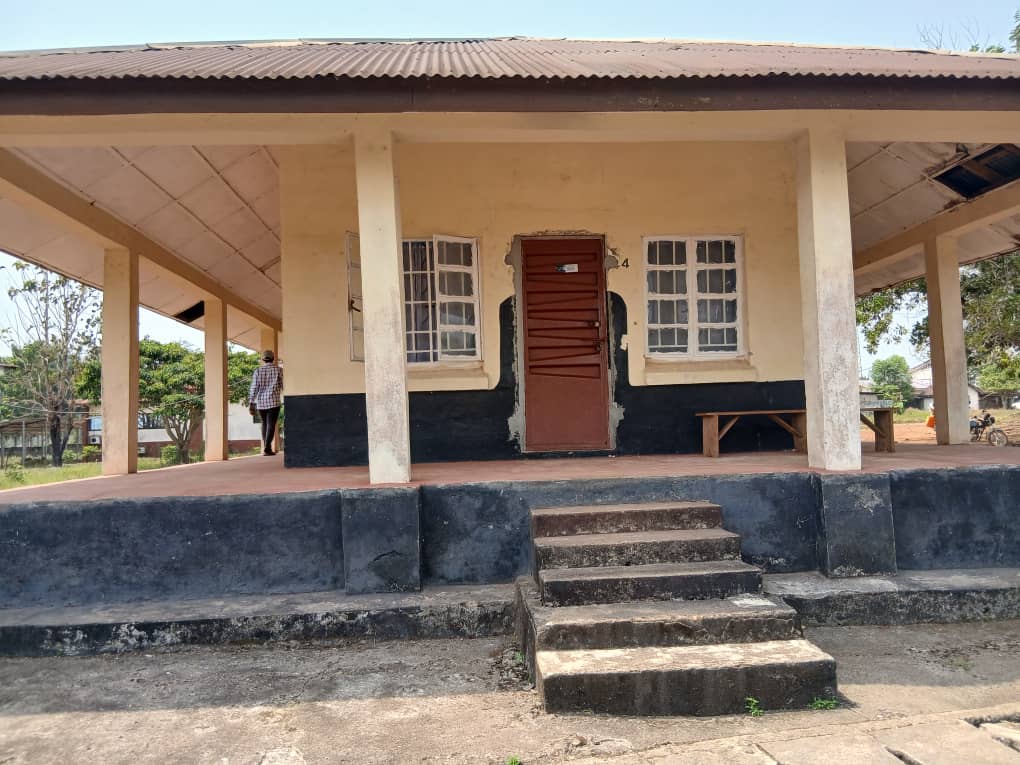
Office of the Ministry of Local Government and Community Affairs, Pujehun District. Image, Brima Sannoh, ManoReporters
The Problem with Local Court Fines
One of the underlying problems with Sierra Leone’s court system is the absence of clearly prescribed fines at the local court level. There are no standardized amounts that guide how much an offender should be fined for specific offenses, making it the discretion of the court chairmen.
As a result, fines are often determined arbitrarily, depending on the individual presiding over the court. Even the Local Court Act of 2011 does not clearly spell out specific fines that local courts should impose, a gap that critics say creates room for abuse, inconsistency, and tensions within communities.
Historical Context: Lessons from the TRC
The 2004 report of Sierra Leone’s Truth and Reconciliation Commission (TRC) documented widespread injustice in the judiciary prior to the 1991-2002 civil war. According to the TRC, arbitrary rulings, corruption, and misuse of judicial authority were among the major contributing factors that fueled grievances and ultimately led to the destruction of thousands of lives and properties during the war. This history highlights that systemic flaws in local justice have deep roots, making reform all the more urgent.
Even Momoh George Kemoh, Chairman of Local Court No. One in Sahn Malen, confirmed that there are no standard fines for cases brought before local courts.
“The fines we levy are based on the gravity of the case and the circumstances surrounding it,” he said.
Kemoh added that heavier fines are often imposed on individuals who are known to be repeat or notorious offenders within their communities.
“Some of the people who receive heavy fines are those who are always causing problems in the community,” he explained. “Imposing such fines is one of the ways we try to discourage them from continuing to commit offences.”
However, both Mohamed Koroma and Adama Kabba said the cases that resulted in the fines were their first ever.
Ministry Confirms Exorbitant Fines Are a Problem
Bashiru Kuyateh, Supervisor of Local Courts at the Ministry of Local Government and Community Affairs in Pujehun District, confirmed to ManoReporters that the chairmen of most local courts in the district routinely levy exorbitant fines on community members, a practice he described as wrong and contrary to the Ministry’s policy.
According to Kuyateh, the indiscriminate imposition of heavy fines has led many litigants to request the transfer of their cases to other parts of the district in search of fair hearings.
“People no longer trust some of the local courts,” he said. “That is why we are seeing increasing requests for cases to be transferred elsewhere.”
He further accused some local court chairmen of collecting large sums of money from complainants without even trying the cases.
“These actions are embarrassing and have the tendency to bring the Ministry’s name into disrepute,” Kuyateh stated.
Kuyateh also explained that the problem is worsened by the fact that many court chairmen lack legal knowledge and formal training in handling cases, noting that a significant number of them are only acting in their positions.
“Because most of them do not have proper legal training, they tend to handle cases anyhow they feel,” he said.
The Local Government official also accused some local court chairmen in Pujehun of showing little respect for the authority of the Ministry, despite repeated warnings to desist from levying fines beyond their jurisdiction. He warned that the government would soon begin to take tougher action against defaulters.
As a way forward, he stressed the need for sustained capacity building within the local court system.
“Regular training for local court officials is key to addressing these problems and restoring public confidence in the courts,” he said.
Civil Society Voices Concern
Civil society leaders in Pujehun District say that while the establishment of the local court system was a positive step, its original purpose has increasingly been undermined over the years.
Isaac Sundifu Koroma, Spokesman of the Civil Society Consortium in Pujehun, said the system was designed to resolve minor disputes at the community level and ease the burden on the formal judiciary.
However, Koroma told ManoReporters that many local courts across Sierra Leone have gradually drifted away from their legally assigned mandates.
“What we are seeing now is that most local courts no longer act within their mandate; they only act as they feel,” he said.
Koroma noted that justice is often compromised through bribery, with court clerks and chairmen playing central roles.
“We have discovered many cases where people who are right are denied justice because of bribery,” he said. “In most of these situations, the injustice is orchestrated by the court clerks together with their chairmen.”
While acknowledging that some individuals routinely violate community by-laws, Koroma warned that such behavior should not be used as justification for abuse of authority by court officials.
“The fact that some people are habitual offenders should never be an excuse for court officials to go beyond their mandate,” he noted.
He attributed the persistent problems within the local court system to a combination of inadequate training and corruption, stressing that structural reforms are urgently needed. Koroma recommended that the government appoint substantive local court chairmen and clerks, similar to the appointment process used for chiefdom administration clerks under the Ministry of Local Government and Community Affairs.
“That level of formal appointment and accountability is what will help restore integrity and public trust in the local courts,” he said.
Looking Ahead
As the debate over fairness and accountability continues, the future of Sierra Leone’s local courts will depend on meaningful reforms that place justice, not discretion, at the center of community dispute resolution.
This story was produced by ManoReporters.com with support from the African Transitional Justice Legacy Fund (ATJLF), through the Media Reform Coordinating Group (MRCG-SL), under the project Engaging Media and Communities to Change the Narrative on Transitional Justice Issues in Sierra Leone.