
• Facebook
  • Twitter
  • YouTube
ManoReporters.com
ADVERTISEMENT
  • Home
  • News
    • All
    • Business and Economy
    • Politics
    • Health
    • Sci-Tech
    • Regional
    • Culture
    Africa CDC officials. Image, Africa CDC

    Mpox: Africa CDC to redeploy experts from Sierra Leone to Liberia

    Dead cattle discovered in a field in Kelima Bendu Town, Foyah District, Lofa County, Liberia. Photo, Tokpa Tarnue, Liberian Daily Observer

    Sierra Leone investigating suspicious skin infections amid fears of anthrax outbreak

    A view of Kpetewoma Village in Bo District, southern Sierra Leone. Image, Joseph Morison, ManoReporters

    Bo: Teacher on the run over alleged sexual penetration

    PhD candidate Wachen Peters of the University of Sierra Leone and College of Medicine and Allied Health Sciences and Koinadugu College’s Center for Biomedical and One Health Research is profiling Hepatitis B Genome for the first time in Sierra Leone. Image, screengrab. Kemo Cham, ManoReporters.

    Studies show “worrying” trend of viral infections in Sierra Leone

    Sierra Leone’s chimpanzees revered as the “Jewel of the Nation” and a symbol of resilience face a dire future as habitat loss accelerates. Image, Emma Black.

    Sierra Leone’s Last Great Apes Refuge Battles Encroachment

    Youth in Mattru Jong participating in an African Youth Movement (AYM) funded agricultural activity. Image, AYM.

    Two Years After Job Promises: Youths Still Cry For Employment in Sierra Leone

    Trending Tags

  • Special Reports
  • Opinion
  • Sports
  • True or False
  • Interview
  • ManoReporters TV
  • Tender and Job
  • Election 2023
No Result
View All Result
  • Home
  • News
    • All
    • Business and Economy
    • Politics
    • Health
    • Sci-Tech
    • Regional
    • Culture
    Africa CDC officials. Image, Africa CDC

    Mpox: Africa CDC to redeploy experts from Sierra Leone to Liberia

    Dead cattle discovered in a field in Kelima Bendu Town, Foyah District, Lofa County, Liberia. Photo, Tokpa Tarnue, Liberian Daily Observer

    Sierra Leone investigating suspicious skin infections amid fears of anthrax outbreak

    A view of Kpetewoma Village in Bo District, southern Sierra Leone. Image, Joseph Morison, ManoReporters

    Bo: Teacher on the run over alleged sexual penetration

    PhD candidate Wachen Peters of the University of Sierra Leone and College of Medicine and Allied Health Sciences and Koinadugu College’s Center for Biomedical and One Health Research is profiling Hepatitis B Genome for the first time in Sierra Leone. Image, screengrab. Kemo Cham, ManoReporters.

    Studies show “worrying” trend of viral infections in Sierra Leone

    Sierra Leone’s chimpanzees revered as the “Jewel of the Nation” and a symbol of resilience face a dire future as habitat loss accelerates. Image, Emma Black.

    Sierra Leone’s Last Great Apes Refuge Battles Encroachment

    Youth in Mattru Jong participating in an African Youth Movement (AYM) funded agricultural activity. Image, AYM.

    Two Years After Job Promises: Youths Still Cry For Employment in Sierra Leone

    Trending Tags

  • Special Reports
  • Opinion
  • Sports
  • True or False
  • Interview
  • ManoReporters TV
  • Tender and Job
  • Election 2023
No Result
View All Result
ManoReporters.com
No Result
View All Result

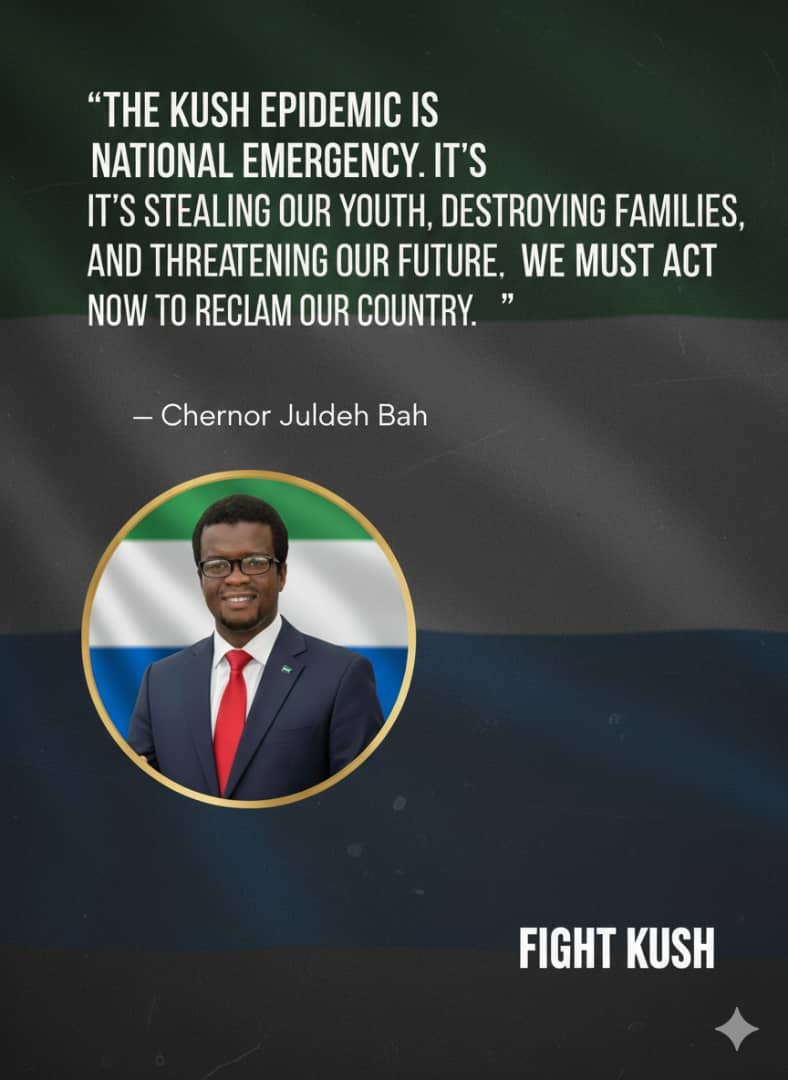
Kush: Sierra Leone’s Silent Genocide — A Call to Urgent, United Action

ManoReporters by ManoReporters
October 16, 2025
in Health, Opinion
0
The Author

The Author

Share on FacebookShare on Twitter

By Chernor Juldeh Bah

ADVERTISEMENT

They call it kush; a cheap, deadly cocktail that arrived like a thief in the night and is stealing our tomorrow.

What started as clandestine packets on street corners has become an epidemic: a synthetic mixture so toxic that chemical tests show it now often contains highly potent synthetic opioids (nitazenes), alongside synthetic cannabinoids and other chemical substances that can kill in a single hit. This is not a moral panic. It is a public-health and security emergency that has already cost too many lives and threatens to hollow out a generation.

Across Freetown and nearby districts, officials of local councils are finding and burying the young and the lost. Figures from these councils and repeated public appeals from the Mayor and district leaders reveal that scores of suspected Kush victims have been collected and interred this year alone, leaving grieving families and overburdened councils to shoulder the human and financial cost. These are not anonymous statistics on a page; they are mothers, fathers, siblings and the bright faces of our towns and villages. 

If we are to have any hope of reversing this tide, three institutions must act now: the security sector, the national government (policy and funding), and the country’s drug-control and public health apparatus. Each has a different but complementary role. Together they can stop the supply of the drugs, save lives, and rebuild hope.

Street arrests and seizures are necessary, but they are not sufficient. Kush is manufactured using imported precursor chemicals and local processing; disrupting raw material flows, dismantling organized networks that traffic chemicals and finished product, and targeting the financiers, are the strategic priorities.

The Transnational Organised Crime Unit, anti-narcotics unit and customs must be provided resources, legally empowered and supported with international cooperation (forensic testing, mutual legal assistance and targeted interdiction). Rapid, forensic drug-testing and chain-of-custody work will allow prosecutions that reach beyond low-level dealers to the networks that profit from death.

But enforcement must be professional, rights-respecting and corruption-free. Heavy-handed or politicised operations that intimidate honest communities will backfire. The security response must be transparent, coordinated with prosecutors, and measured against dismantling supply chains, not headline arrests.

The President’s declaration of a national emergency rightly recognised Kush as an existential threat. That declaration must translate into sustained funding, a clear national plan, and measurable results not episodic press conferences. A national taskforce was formed; it must be resourced with health specialists, forensic chemists, law enforcement, social-services experts and representatives of local government, and given a public timeline, targets and independent oversight. 

Councils are already paying the bill in human terms and in cash, burying victims, managing public cemeteries, and cleaning up scenes of horror. The state must compensate and support local authorities to carry out dignified burials, victim identification, psychosocial support for families, and community outreach programs. There must be a national rehabilitation and treatment scale-up plan, hospital beds, mobile outreach teams, and community rehabilitation centres, because criminalisation alone will neither cure addiction nor stop deaths. WHO, UNODC and regional partners must be engaged to supply technical support and training. 

We cannot treat what we cannot test. Routine chemical testing of seized samples and biological samples (where ethical and possible) is essential to identify the evolving composition of Kush and to guide clinical responses (for example, which opioid antagonists may be effective). Public health agencies must publish transparent, regular reports on toxicology and mortality so clinicians, first responders and communities know what they face. At the same time, scale up evidence-based harm-reduction: outreach to users, distribution of life-saving emergency kits where appropriate, training for first responders in overdose recognition and management, and rapid expansion of addiction treatment services. Rehabilitation cannot be a one-time political photo op; it must be a sustained, community-based continuum of care with social reintegration, job training and family counselling.

The fight against Kush cannot be left to hospitals and police alone. Schools, religious institutions, community leaders and youth groups are the first line of prevention. Early-warning hotlines, community patrols to secure cemeteries (to stop grave-robbery and the further mixing of human remains into drugs), mentorship programs, livelihood projects for vulnerable youth and public civic education campaigns must be funded and supported. Communities are not helpless victims; they are essential partners. 

Kush kills irrespective of political party, ethnicity or class. When we politicise every response, when arrests become talking points and rehabilitation centres become campaign props, we bankrupt our common purpose. This crisis demands cross-party unity, uninterrupted funding, and national leadership measured by lives saved rather than votes won. The voices of survivors, bereaved families, health workers and local councils must set the priorities, not partisan calculations.

Concrete, urgent demands I call on leaders to accept today.

1. A publicly accountable national plan with clear targets and a funded two-year implementation budget (prevention, enforcement, treatment, and socioeconomic reintegration).

2. Immediate expansion of forensic testing capacity and public reporting of findings (what chemicals are present; how many deaths; geographic hotspots).

3. Strengthen and resource, the Transnational Organised Crime Unit and customs to disrupt precursor chemical imports and dismantle trafficking networks with regional and international cooperation.

4. Rapid scale-up of community rehabilitation, mental-health services and youth employment schemes in hotspot neighbourhoods.

5. A non-partisan national commission (with civil society, religious leaders and youth representatives) to oversee cemeteries, bury victims with dignity, support families, and prevent grave-robbery.

Every number in an official report hides a life; every burial count is a family broken. The statistics we now read councils burying scores of suspected Kush victims are a wake-up call. If the Freetown City Council and the Western Area Rural District Council are burying dozens and dozens of bodies this year, that is not a matter for complacency or blame-shifting. It is a demand for decisive action from all of us.

This is not a problem that will vanish while we argue. It will only be solved by coordinated, sustained and compassionate action by police who break networks, by governments who fund recovery, by health workers who treat without shame, by communities who protect their own, and by citizens who refuse to reduce human tragedy into partisan noise. Let us choose to be remembered not for the years when our youth died quietly on pavements and in alleys, but for the years when Sierra Leone rose together with courage, clarity and compassion and reclaimed its children.


ADVERTISEMENT
Previous Post

Merck Foundation Luminary: “We are making history together” – Prof. Stangenberg-Haverkamp

Next Post

GAVI urges Sierra Leone to take ownership of national immunization programme

ManoReporters

ManoReporters

Next Post
GAVI urges Sierra Leone to take ownership of national immunization programme

GAVI urges Sierra Leone to take ownership of national immunization programme

Stay connected

  • Trending
  • Comments
  • Latest
State security forces man a checkpoint at an intersecition between State House and Siaka Steven Street in Freteown. Photo credit, Ishmail Kindama Dumbuya

Breaking: Sierra Leone gov’t says it ‘rebuffed’ attempted break into armory

November 26, 2023
Sarah Van Horne, Public Affairs Officer, US Embassy in Freetown. Photo credit, Courtesy.

Sierra Leone: US considering further actions after visa ban – Embassy spokeswoman

September 1, 2023
Anthrax Outbreak: Sierra Leone records first human cases

Anthrax Outbreak: Sierra Leone records first human cases

May 22, 2022
Former Guinea junta leader Moussa Dadis Camara and the two other close allies of his who are thought to have escaped from prison in Conakry on Saturday, November 4. Image by Guinea News.

Breaking! Guinea: Heavy gunfire reported in Kaloum, around central prison

November 4, 2023
Diabetes: The “Ticking Time Bomb” for Africa! Are we sitting on it?

Diabetes: The “Ticking Time Bomb” for Africa! Are we sitting on it?

0
Sierra Leonean on trial for war crimes in Liberia released

Sierra Leonean on trial for war crimes in Liberia released

0
Sierra Leone, France seek tighter cooperation

Sierra Leone, France seek tighter cooperation

0
Wellington Fire Disaster: Victims Benefit From Fullah Progressive Union Largesse

Wellington Fire Disaster: Victims Benefit From Fullah Progressive Union Largesse

0
Africa CDC officials. Image, Africa CDC

Mpox: Africa CDC to redeploy experts from Sierra Leone to Liberia

November 21, 2025
Dead cattle discovered in a field in Kelima Bendu Town, Foyah District, Lofa County, Liberia. Photo, Tokpa Tarnue, Liberian Daily Observer

Sierra Leone investigating suspicious skin infections amid fears of anthrax outbreak

November 19, 2025
A view of Kpetewoma Village in Bo District, southern Sierra Leone. Image, Joseph Morison, ManoReporters

Bo: Teacher on the run over alleged sexual penetration

November 18, 2025
PhD candidate Wachen Peters of the University of Sierra Leone and College of Medicine and Allied Health Sciences and Koinadugu College’s Center for Biomedical and One Health Research is profiling Hepatitis B Genome for the first time in Sierra Leone. Image, screengrab. Kemo Cham, ManoReporters.

Studies show “worrying” trend of viral infections in Sierra Leone

November 16, 2025

Recent News

Africa CDC officials. Image, Africa CDC

Mpox: Africa CDC to redeploy experts from Sierra Leone to Liberia

November 21, 2025
Dead cattle discovered in a field in Kelima Bendu Town, Foyah District, Lofa County, Liberia. Photo, Tokpa Tarnue, Liberian Daily Observer

Sierra Leone investigating suspicious skin infections amid fears of anthrax outbreak

November 19, 2025
A view of Kpetewoma Village in Bo District, southern Sierra Leone. Image, Joseph Morison, ManoReporters

Bo: Teacher on the run over alleged sexual penetration

November 18, 2025
PhD candidate Wachen Peters of the University of Sierra Leone and College of Medicine and Allied Health Sciences and Koinadugu College’s Center for Biomedical and One Health Research is profiling Hepatitis B Genome for the first time in Sierra Leone. Image, screengrab. Kemo Cham, ManoReporters.

Studies show “worrying” trend of viral infections in Sierra Leone

November 16, 2025
ADVERTISEMENT
Contact

info@manoreporters.com | Freetown, Sierra Leone

Contact

info@manoreporters.com | Freetown, Sierra Leone

© 2022 Powered by Manocommunication.com
No Result
View All Result
  • Home
  • News
    • Business and Economy
    • Politics
    • Health
    • Sci-Tech
      • Data
    • Regional
    • Culture
  • Special Reports
  • Opinion
  • Sports
  • True or False
  • Interview
  • ManoReporters TV
  • Tender and Job

© 2022 Powered by Manocommunication.com