










By Chernor Juldeh Bah
The strength of local government is measured by its ability to serve communities. Behind every council service are workers whose commitment keeps public administration moving, often under difficult conditions. Their contribution deserves recognition through salaries and conditions of service that reflect the responsibilities they carry.
This is a respectful appeal to the Government of Sierra Leone, particularly the Ministry of Finance through its Fiscal Decentralisation Division (FDD), to give greater attention to the remuneration and welfare of local council staff.
Sierra Leone restored elected local councils in 2004 after the system had been abolished in 1972. This was an important step in rebuilding governance after the civil war and bringing decision-making closer to citizens. Twenty-two years later, the institutions carrying that vision forward need sustained investment in their workforce.
Since their restoration, councils have progressively assumed significant legal, administrative and service-management responsibilities. Their role in supporting basic services, including health and education, has been recognised by the World Bank. These responsibilities make councils essential to translating national development ambitions into practical benefits for communities.
Council staff prepare development plans, manage finances, mobilise revenue, oversee procurement, monitor projects, communicate public decisions and engage communities. They work where government meets the daily concerns of citizens, where explanations are demanded and results are expected.
We are also addressing waste management challenges that directly affect public health, the environment and the dignity of our communities. At WARDC, this includes public education, community engagement, coordination with service providers and support for cleaning activities. The work requires persistent efforts to encourage proper disposal, discourage indiscriminate dumping and build a shared sense of responsibility among residents and businesses.
Waste management does not end with a cleaning exercise. Keeping communities clean requires follow-up, supervision, public cooperation and consistent communication. Council staff must help turn awareness into everyday practice while responding to complaints and competing demands.
These responsibilities require time, professional judgment and resources. An officer educating communities about sanitation, a revenue officer engaging businesses, or a monitoring officer following a development project contributes directly to the effectiveness and credibility of government.
Yet dedication alone cannot pay transport fares, meet medical expenses, provide accommodation or support a family. Public servants working at the grassroots face the same household obligations as their colleagues elsewhere in government. Their welfare deserves equal seriousness.
Government’s previous intervention must be acknowledged. The Ministry of Finance’s first-half fiscal report for 2025 confirms that core local council staff received a 30 per cent salary increase. That was a welcome step and provides a foundation for further improvement.
The question now is whether the resulting salaries adequately reflect the cost of living, the demands of the work and compensation for comparable responsibilities across Ministries, Departments and Agencies. A percentage increase matters, but its practical value depends on the amount an employee ultimately takes home and what that amount can reasonably provide.
A worker can appreciate an increase and still struggle to meet essential needs. Recognising that reality should strengthen the case for a comprehensive review of council staff remuneration.
Local councils bring together a wide range of public responsibilities within one institution. Their staff must respond to development needs, financial obligations, environmental concerns and public expectations, often within limited budgets. This breadth of work deserves appropriate recognition in public-sector pay arrangements.
The comparison with other MDAs is a question of fairness. Qualifications, experience, accountability and equivalent responsibilities should carry appropriate weight wherever an officer serves. A professional’s contribution should not receive less recognition simply because the duty station is a district council rather than a central government institution.
Fairness also requires looking beyond basic salary. Transport and communication support, medical provision, pension arrangements and opportunities for promotion all influence an employee’s welfare and motivation. These considerations matter especially for staff whose duties require regular movement between communities.
Financial pressure can weaken morale and make it harder to retain capable workers. When experienced employees leave, councils lose institutional knowledge and continuity. When staff struggle to cover essential duty-related costs, fieldwork and community engagement can suffer. Citizens eventually feel the consequences.
Improving compensation would help councils retain skills, strengthen professionalism and sustain the attention that effective service delivery requires. Better welfare should accompany clear expectations for attendance, integrity, accurate reporting and responsible management of public resources.
Sierra Leone’s financial constraints are real, and any adjustment must be affordable and properly funded. A phased improvement would still demonstrate a serious commitment to fairness. What matters is that council staff welfare becomes a clear priority, supported by a credible path towards better conditions.
The Government’s investment in decentralisation will be stronger when it recognises the people responsible for making it work. Buildings, policies and development plans need a motivated workforce to produce lasting results.
This appeal reaches beyond the interests of council employees. It concerns the resident seeking assistance, the trader expecting a clean market, the community awaiting a project and the taxpayer demanding accountability. Each depends on council staff who can perform their duties with competence, confidence and dignity.
The Ministry of Finance, through FDD and the relevant institutions, has an opportunity to strengthen local governance by giving council staff remuneration the attention it deserves. A meaningful salary review would send a clear message that service at the grassroots is valued within Sierra Leone’s public administration.
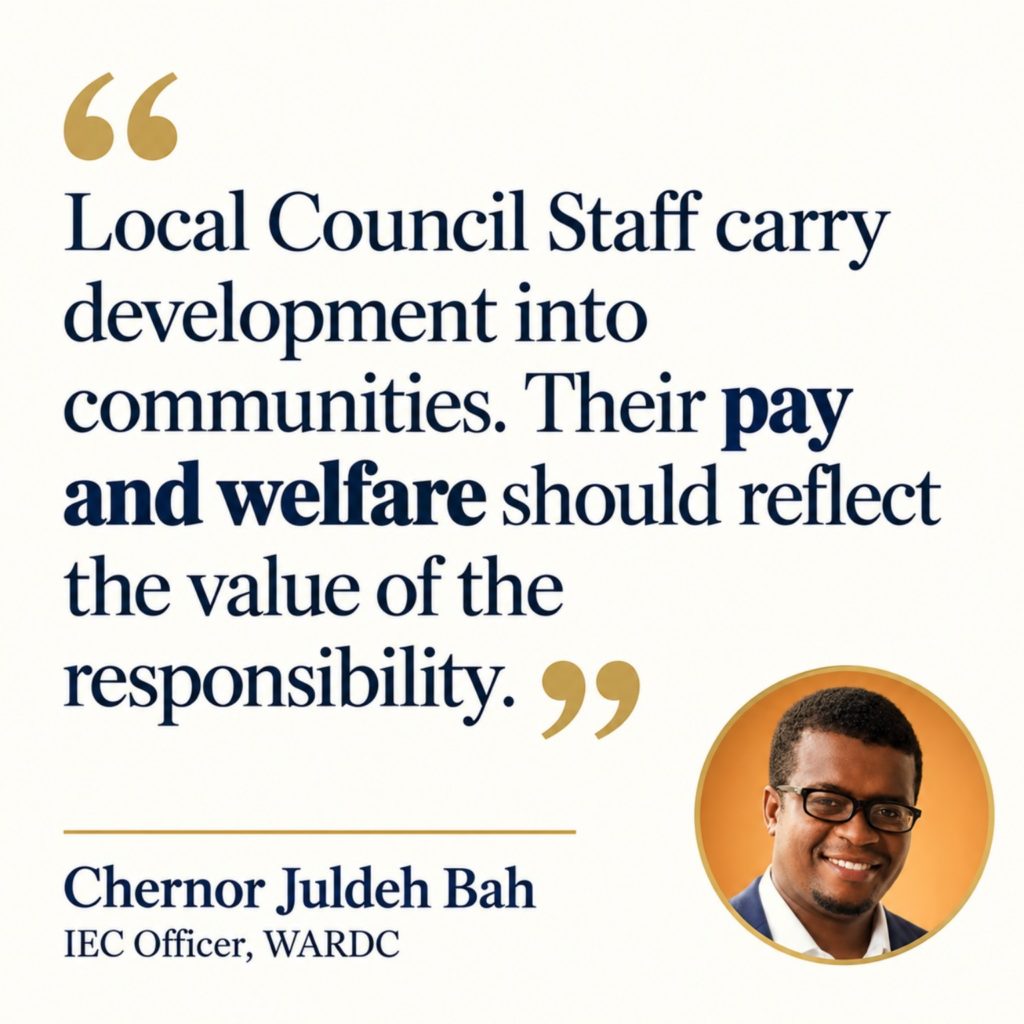
Local council staff carry development into communities. Their pay and welfare should reflect the value of that responsibility.
The author is the Information, Education and Communication Officer at the Western Area Rural District Council. He can be reached on Tel: 079359906.