








By Brima Sannoh
In the quiet farming village of Benga in Kpanga Chiefdom, just two and a half miles from Pujehun Town, the day begins long before sunrise for many women. By 5am, Hawanatu Koroma and Hokie Hobei—two mothers of four—are already on a narrow footpath, plastic buckets balanced on their heads, making the now-familiar journey in search of water. But in this dry season, their journey has grown longer, harder, and more uncertain.
Even in the Pujehun township, the situation is not much better. A few sections rely on pump water and public taps, but these limited sources are now stretched beyond capacity. Water supply is increasingly rationed during the dry season, and there are days when residents go without water from key points such as Jah Section, Stook Road, the main Court Barray, and the Holy Family Primary School.
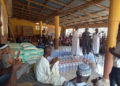
Back in Benga, the pressure is even more severe: the village has more than 800 houses and an estimated population of about 1,000 people, all depending on scarce and unreliable water sources. The situation is further compounded by the fact that the community largely depends on a single hand pump located at the center of the village, where long queues form daily and tensions often rise as residents struggle to access water. There are even days when the entire community is left without water after the main source runs dry. In such moments, some residents resort to unsafe alternatives, including an unprotected well on the outskirts of the village.
Some lactating mothers have reported cases of diarrhea after using water from these unsafe sources, raising serious concerns about the broader public health implications of the crisis.
“There used to be a well just behind our village,” Hawanatu Koroma explains to ManoReporters, her voice tired but steady. “But each time I give that water to my child, the child gets diarrhea. Now we depend on the only hand pump, and it dries up before midday. If you don’t come early, you will not get water.”
Hokie Hobei also told ManoReporters that what was once a routine chore has turned into a daily struggle. “Sometimes we walk for over an hour. When we reach the stream, there are already many people waiting. Everyone is tired, everyone is desperate. That is when arguments start.”
At the few remaining water points, long queues snake through the villages. Children miss school; women lose valuable farming time; and tensions simmer beneath the surface. What begins as a disagreement over whose turn it is to fetch water, can quickly escalate into heated exchanges—sometimes dividing neighbors who have lived peacefully together for years.
In Benga, these tensions have at times turned physical. Women and young girls have reportedly engaged in fights as they struggle to access water from the community’s only hand pump.
Despite several reports made to local authorities in Pujehun seeking urgent intervention, residents say their appeals have so far fallen on deaf ears.
“We have reported this problem many times, but nothing has changed,” said Moris Massaquoi, a resident of Benga, speaking to ManoReporters.
“Our women are suffering every day to get safe and clean water. Even preparing food now takes a very long time because they have to spend hours looking for water.
This situation is affecting families, and in some cases, it is even contributing to hunger.”
But the crisis extends far beyond a single village
Across Sierra Leone, from urban centers to suburban settlements and rural communities, access to safe and reliable water remains a growing challenge. Experts point to climate change as a major driver, alongside harmful environmental practices such as deforestation, unregulated mining, and charcoal burning—all of which are contributing to the depletion of water sources nationwide.

This growing strain is not unique to Benga
About seven and a half miles away, in Massahun town—the headquarters of Kpaka Chiefdom—similar frustrations are unfolding. For Michael Sillah, a local farmer, the dry season now brings more than just poor harvests; it brings conflict.
“Water is life,” he says, standing beside a shrinking stream that once sustained the town. “When the water reduces, people become angry. Families argue. Even within households, there is tension because everyone depends on the same small source.”
Mr Sillah note that while the community has experienced hot weather and water shortages over the past few years, 2026 has proven to be the most severe.
“We have been experiencing this for some years now, but this year is the worst,” he explains to ManoReporters.
“Most of our water sources dried up as early as January. It has affected our plantation farming—cocoa and oil palm. Production is going down.”
Sillah recalls a recent dispute at a community well that nearly turned violent. “It started with a simple misunderstanding. But when people are stressed and tired, small things become big problems.”
Across Pujehun District, such stories are becoming increasingly common. Wells that once served entire communities are running dry earlier each year. Streams are shrinking. And the pressure on the few available water sources is intensifying.
Local leaders are beginning to take notice.
A community elder in Sahn Malen, Pujehun District, Patrick Sengbeh Alpha, acknowledges that water scarcity is quietly eroding social cohesion.
“In the past, we had our differences, but water was not one of them. Now, it is becoming a serious issue. If not addressed, it can divide our communities.”
Officials of the Ministry of Water Resources in Pujehun have also acknowledged the urgency of the problem, pointing to the need for stronger partnerships between government, NGOs, and local communities.
Mohamed Pessima, District Coordinator of the Ministry of Water Resources in Pujehun, cited collaborative efforts of some organizations that have seen communities provided boreholes and wells.
“We have not been able to do much as a ministry due to the lack of government subvention throughout 2025 and the first quarter of 2026,” Pessima told ManoReporters.
“However, we commend the collaborative efforts of partners like Save the Children International and World Vision, who have been supporting communities with wells and boreholes,” he said. “The challenge is also being worsened by illegal mining, bush burning, charcoal production, and deforestation, which continue to expose our water sources to harsh climatic conditions despite ongoing community awareness campaigns.”
Adding a civil society perspective, Abdulai Jalsil Sillah, a member of the Pujehun District Human Rights Committee and Executive Director of Youth in Action for Development (YAD) Sierra Leone, said funding challenges facing government Ministries, Departments and Agencies have slowed service delivery, including services from the Pujehun District Council, Ministry of Health, and Ministry of Water Resources and Sanitation. However, he stressed that such constraints cannot justify citizens being deprived of essential services.
“There should be no excuse for people to go without basic essential services, especially water, which is a life connecting cable,” Abdulai said. He urged government to do everything possible to ensure that people in Pujehun and across Sierra Leone have sustainable access to safe and clean drinking water, describing it as a fundamental human right.
These concerns echo long-standing findings of Sierra Leone’s Truth and Reconciliation Commission (TRC), which identified poor governance, weak service delivery, and unequal access to basic social services as structural drivers of local-level conflict and community frustration. The Commission, in its report in 2004, warned that competition over scarce resources such as water, land, and public services, if left unaddressed, could deepen tensions and undermine peace at community level.
The TRC recommended that government prioritises equitable service delivery, strengthen local governance systems, and ensure rural communities are not left behind in national development.
In the context of Pujehun, the current water crisis reflects many of these concerns, as communities increasingly compete for limited and unreliable water sources under worsening climatic conditions.
Adding a humanitarian perspective, John Kainese of Save the Children International, Pujehun branch, emphasized that improving water access requires stronger investment in sustainable systems and community-based management.
“We need to invest in sustainable water systems—boreholes, protected wells, and storage facilities—but also empower communities to manage these resources fairly,” Mr Kainese said. “When people have a system they trust, conflicts reduce.”
Back in Benga, Hawanatu Koroma and Hokie Hobei finally reach the stream after a long walk. The water is shallow, and they must dig small holes in the sand to collect enough for their families. Around them, other women wait patiently, some exchanging quiet words, others watching closely to ensure fairness.
Despite the hardship, there is still a sense of resilience in them.
“We don’t want to fight,” Hobei says softly. “We just want enough water for our homes.”
Her words capture both the struggle and the hope shared by many in Pujehun: that with the right support, access to water can become a source of unity rather than conflict.
As the dry season deepens, the question many people are now asking is: how long can communities continue to endure before scarcity pushes them further apart? And more importantly, what will it take to turn the tide?
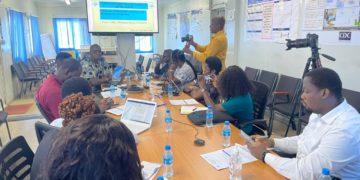
This report was produced with support from the Africa Transitional Justice Legacy Fund (ATJLF), through the Media Reform Coordinating Group (MRCG), under the project: ‘Engaging the Media and Communities to Change the Narrative on Transitional Justice Issues in Sierra Leone.