








By James Tamba Lebbie
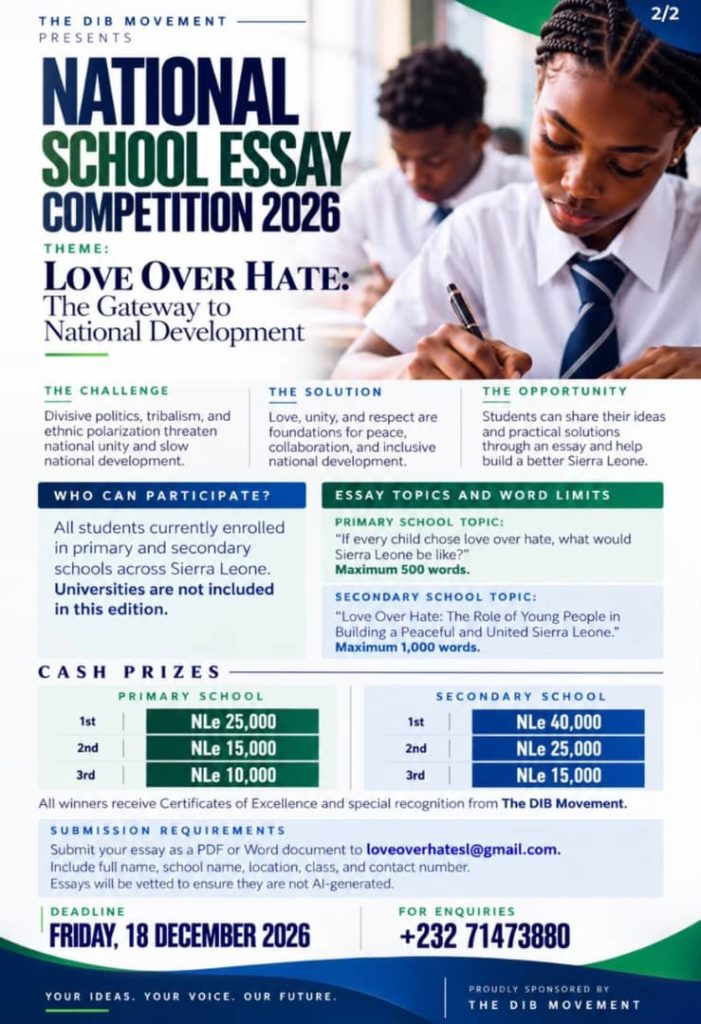
In moments of national reflection, when questions of cohesion, tolerance and the moral direction of a nation demand sober attention, societies that endure are those that deliberately invest in the conscience and consciousness of their young. It is within this historical and moral context that the Dr. Ibrahim Bangura (DIB) Movement has unveiled one of its most compelling civic education initiatives to date: The National School Essay Competition 2026.
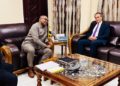
Launched under the distinguished leadership of Dr. Ibrahim Bangura, Leader of the DIB Movement and Flagbearer Aspirant of the All People’s Congress (APC), the competition is convened under a theme both timely and timeless: “Love Over Hate: The Gateway to National Development.”
Far beyond a conventional academic contest, it is an intellectual call to conscience; an invitation to the nation’s pupils and students to interrogate, articulate, and reimagine the values upon which a peaceful and prosperous Sierra Leone must be built.
A Vision Beyond Infrastructure
For Dr. Bangura, whose public philosophy has consistently emphasised integrity, inclusivity and enlightened leadership, national development cannot be reduced to Gross Domestic Product, kilometres of asphalt, or the number of classrooms constructed. While these are indispensable, they are insufficient. True development, he argues, is ultimately a function of the quality of human relationships, the resilience of social trust, and the capacity of a people to transcend parochialism. Tribalism, intolerance, political hatred and social division are not mere cultural inconveniences; they are structural impediments to progress, corroding collective will and subverting national potential. It is precisely this insight that lends the competition its profound national relevance.
By asking young Sierra Leoneans to examine, through reasoned argument, why a nation must consciously choose love over hate, the DIB Movement seeks to cultivate a generation of reflective citizens who understand that national unity is not a slogan to be chanted at political rallies, but a civic discipline to be practised in homes, schools, playgrounds and communities.
Education as Formation, Not Merely Instruction
At the heart of Dr. Bangura’s educational philosophy is a conviction that has defined great statesmen and educators: that the destiny of a nation is forged not only by what its children are taught, but by the values they internalise, the perspectives they acquire, and the sense of agency they are empowered to exercise. Education, in this conception, must transcend the transmission of facts. It must form character. It must inculcate tolerance where prejudice tempts, foster empathy where indifference prevails, nurture intellectual curiosity where complacency persists, and inspire responsible citizenship where cynicism threatens.
This competition operationalises that philosophy. It challenges participants to move beyond rote learning and regurgitation to independent inquiry; to weigh evidence, construct arguments, advance original ideas, and proffer solutions to the very challenges that confront their communities. In doing so, it affirms education as both an instrument of personal transformation and a cornerstone of national renewal.
The capacity to think critically, to write persuasively, and to engage difference with civility is, after all, the bedrock of democratic participation and ethical leadership. By institutionalising these competencies at the formative stage, the initiative seeks to raise a generation that will confront national disagreements not with invective and hostility, but with dialogue, reason and mutual respect.
A Truly National Conversation
Open to eligible pupils in primary and secondary schools across all regions of Sierra Leone, the competition is deliberately inclusive; a “national common” where young people from diverse geographic, cultural and socio-economic backgrounds converge in a shared intellectual enterprise. While attractive cash prizes, certificates of excellence and national recognition await outstanding entrants – incentives designed to reward diligence and celebrate merit – the deeper significance of the initiative transcends material reward. It is about affirming to every Sierra Leonean child that his or her voice matters; that ideas conceived in a classroom in Kailahun, Koinadugu, Portloko, Bonthe or Freetown can shape the national discourse; that intellectual confidence is itself an act of patriotism.
A Call to Collective Guardianship
Dr. Bangura has issued a clarion call to the custodians of learning – school administrators, teachers, parents and guardians – to embrace this national endeavour with enthusiasm and purpose. Teachers, as moral and intellectual mentors, bear a solemn responsibility not merely to instruct, but to inspire; not merely to examine, but to awaken the latent potential within each learner. Parents and guardians, in turn, are urged to nurture environments where curiosity is encouraged, effort is celebrated, and academic excellence is understood as a pathway to service.
The Moral Imperative
Underlying the theme “Love Over Hate” is an inescapable truth about nation-building: No nation can achieve its full promise when division is weaponised, when diversity is treated as liability rather than strength, and when citizens lose the capacity to see in one another a shared humanity. Sierra Leone’s progress demands more than common borders and shared symbols. It requires a conscious, collective commitment to trust-building, to the affirmation of dignity irrespective of ethnicity, region, political affiliation, religion or social status.
To choose love over hate, therefore, is not an act of sentimentality. It is an act of statesmanship. It is a deliberate decision to repudiate prejudice, to reject intolerance, to embrace dialogue over diatribe, and to subordinate narrow interest to the imperatives of the common good. It is to build bridges where walls have been erected, and to place country above self. This is the national conversation the DIB Movement seeks to ignite – one that connects the chalkboard to the broader architecture of national development, and invites young people to reflect not only on the society they will inherit, but on the society they must have the courage to build.
Conclusion: Investing Today for Tomorrow
Ultimately, the true measure of the National School Essay Competition 2026 will not be found solely in the eloquence of the winning essays or the prestige of the awards. It will be found in whether its central message takes root in our schools, resonates in our homes, and reverberates in our communities. Through this initiative, Dr. Ibrahim Bangura and the DIB Movement are articulating a proposition that is both urgent and enduring: that Sierra Leone’s future must be founded not on hatred and division, but on knowledge, tolerance, unity and an abiding commitment to the collective welfare.
For if we aspire to bequeath to posterity a peaceful, united and prosperous Sierra Leone, the work must begin with our children today. And if that future is to endure, love must cease to be a mere slogan. It must become a national ethic, a civic culture, and the guiding principle of our shared destiny.
Love over hate. Unity over division. Knowledge over ignorance. Nation-building over narrow interests.
That, in essence, is the enduring philosophy animating the DIB Movement’s National School Essay Competition 2026.